This product was designed by LeoNerd's Store.
By buying this product you support original hardware creators.


Develop applications using the AVR 1-series ATtiny412
Summary
- ATtiny412 breakout
- UPDI+ programming header
- Status LED
- Reset button
What is it?
This board holds an AVR ATtiny412 microcontroller, providing access to all of the IO pins. It adds power supply decoupling capacitors, an LED, a button, and UPDI programming header to make a convenient self-contained development board for small microcontroller projects.
The LED is attached to the PA3 pin via a 2k2 current-limiting resistor (note that this is unlike my other AVR 1-series boards, which use PA7).
The button is attached to the PA0 UPDI/RESET# pin via a series resistor to prevent damage in case of drive contention. Note that the PA0 pin defaults to UPDI mode. Switching the pin to RESET mode will require the use of a 12V-capable UPDI programmer if you want to program the chip after this.
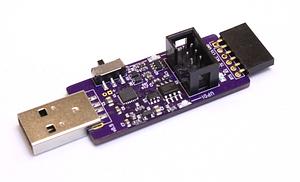
The board also provides a programming header in the AVR standard 2x3 layout. Note that this will requires a UPDI-capable programmer. An SPI-style ISP programmer will not work with this chip. This programming header also includes the USART.0 TX and RX signals in "UPDI+" layout, allowing single-cable programming and debug with a suitable programmer.
Finally, an extra 2-pin header is provided with another VCC and GND pin in case additional connections are required.
Reference icons are placed next to the pins used by the USART, I²C, SPI, and DAC modules, and where the LED is connected, to remind you what functions those pins usually perform.
This board is supplied with two 4 pin header strips for the IO pins and one 2x3 pin for the programming connector.
ATtiny412
The ATtiny412 is one of the new AVR 1-series microcontrollers, containing xmega-style peripherals. These are more powerful and flexible than previous generations of ATmega and ATtiny chips.
This particular chip contains 4 KiB of flash and 256 bytes of RAM on an AVR CPU clocked at 20 MHz. It provides two 16bit and one 12bit PWM-capable timers, a 16bit realtime counter, a USART with fractional baud rate generator, a master/slave capable SPI interface, I²C interface, analog comparator, 10bit ADC, 8bit DAC, and in total 6 IO pins. It also provides a 6-channel event system and configurable custom logic block that can route events between peripherals without waking the CPU.
More information can be found on Microchip's website at https://www.microchip.com/wwwproducts/en/ATTINY412
Why did you make it?
I wanted to experiment with the new AVR 1-series chips, but couldn't find any maker-oriented hardware for them.
What makes it special?
I believe this may be the first use of an ATtiny412, outside of the development boards produced by Microchip themselves.
Related Products
| Size | AVR 1-series | AVR 2-series |
|---|---|---|
| 8pin, 4KiB flash | ATtiny412 | - |
| 14pin, 8KiB flash | ATtiny814 | ATtiny824 |
| 20pin, 16KiB flash | ATtiny1616 | ATtiny1626 |
| 24pin, 32KiB flash | ATtiny3217 | ATtiny3227 |
- AVR UPDI Programmer with 12V A USB UPDI programmer with a second serial port and 12V pulse generator
Links to code and documentation
No additional links provided for this product.
Product HS Code: 853710
Shipping policy
No information available.
Here are some extras that might be useful for your project!
ATtiny412 Development Board
Sold by LeoNerd's Store
$11.73
No tax for United States [change]
Stock available: 7
The seller

Custom test equipment, digital electronics, microcontrollers, C and Perl programming alongside them.